

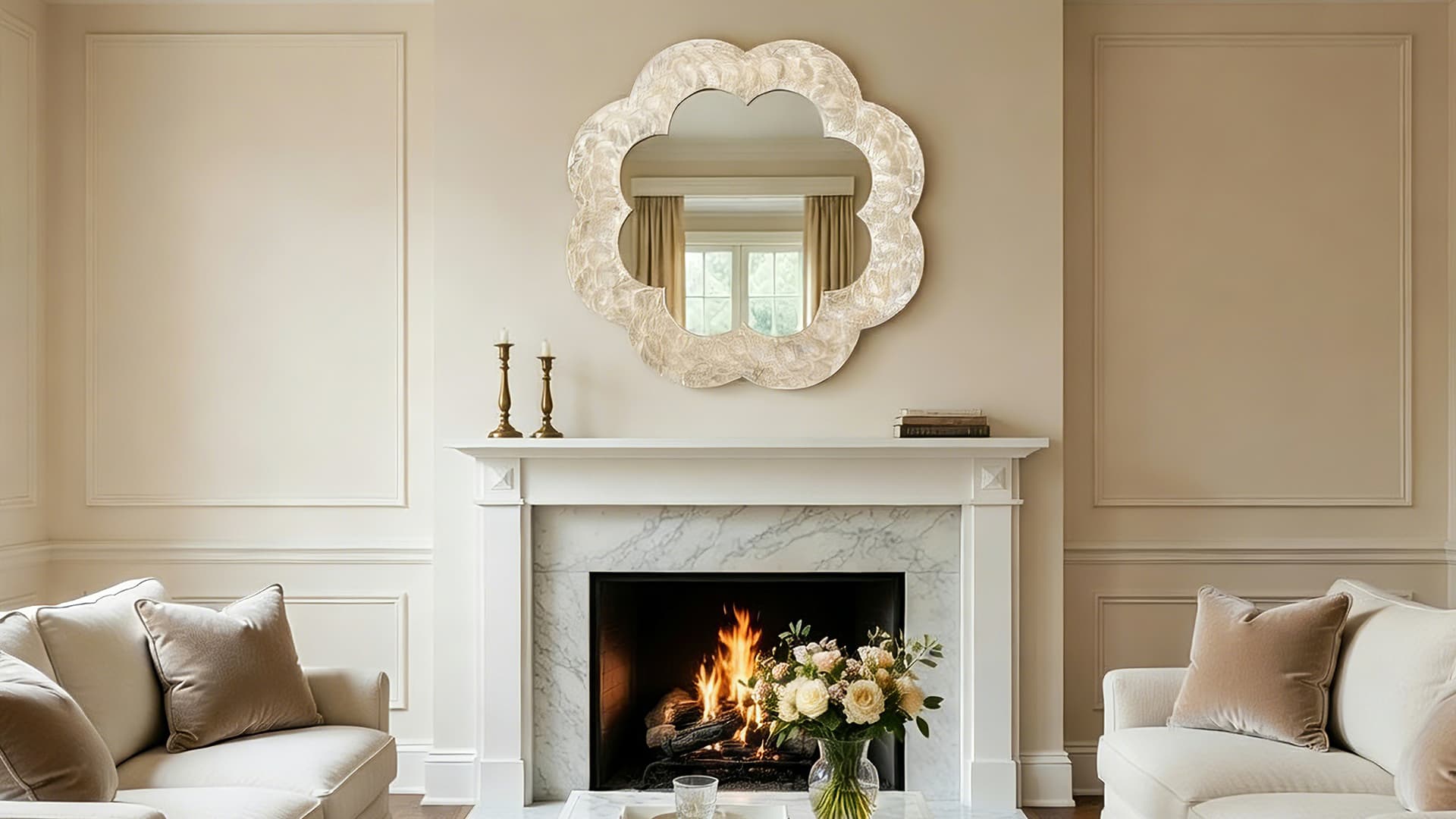
In modern home design, mirrors are no longer just practical items used for checking one’s appearance; they have evolved into core elements that reshape spatial ambience and express personal style. From organic-sculptural shapes to smart technology integration, and from natural material pairings to bold dimensional innovations, the design of home accent mirrors in 2025-2026 revolves around four key directions: creative shaping, personalized expression, smart functional integration, and ingenious spatial application, striking a delicate balance between artistic expression and everyday practicality. This article delves into these trends to unpack the spatial aesthetic logic behind accent mirrors.
I. Organic-Sculptural Irregular Shapes
Organic and irregular shapes have emerged as one of the most influential trends in mirror design at present, completely breaking away from the rigid geometric lines of traditional rectangular mirrors. Rooted in smooth curves, naturally irregular contours, teardrop shapes, capsule silhouettes, ovals, and rounded-corner designs, these mirrors create visual aesthetics that blend softness with sculptural appeal. Drawing inspiration from natural forms and textures, their asymmetrical lines infuse interior spaces with a warm, tactile feel and dynamic aesthetic, effectively softening the stark coldness of structured, linear spaces and lending the entire environment a more relaxed, gentle, and vibrant vibe.
Mirrors with organic shapes are highly compatible with modern, Scandinavian, and minimalist interiors. They serve a practical purpose while also acting as standalone wall art, often becoming the focal point of living room accent walls, bedroom vanity areas, or entryways. Their naturally flowing shapes add design interest without overwhelming the space, perfectly aligning with the growing demand for understated chic and minimalist sophistication in contemporary spatial design.
II. Oversized Mirrors and Mirror Walls
Oversized mirrors and full-wall mirror installations are a design trend that continues to gain momentum in 2025–2026, with their core value lying in spatial visual expansion and elevated luxury. For small apartments, narrow spaces, or areas with limited natural lighting, oversized mirrors break the boundaries of physical space by reflecting light and surrounding scenes, making compact areas feel more open, spacious, and transparent. Full-wall mirror installations, on the other hand, create an immersive sense of spatial extension, infusing high-end residences and light-luxury-style interiors with a sophisticated sense of opulence.
Such mirror designs are most commonly paired with sleek, thin frames or frameless styles to avoid the oppressive feeling brought by bulky, overly thick frames. They are suitable for a wide range of areas, including living rooms, bedrooms, and hallways, and can even serve as decorative backdrops for bedroom headboards, achieving a seamless fusion of practicality and aesthetics.
III. Personalized Frames and Innovative Materials
Frame design and material selection are key hallmarks for showcasing home personalization. The 2025–2026 trends retain the timeless appeal of minimalist frameless designs while embracing more creative expressions in frame materials and colors, with the core design logic centered on echoing home hardware finishes and aligning with the overall spatial style.
- Frameless designs: Still the top choice for minimalist interiors, their clean edges allow mirrors to blend seamlessly into walls, accentuating the sleek, refined aesthetic of the space.
- Slim metal frames: Mirrors with slim frames in matte black, brass, and antique gold have become mainstream. Their slender profiles occupy minimal visual space, while the metallic texture echoes home hardware such as doorknobs, light fixtures, and cabinet pulls, bolstering the cohesive design language of the entire space.
- Natural material frames: Rattan- and willow-framed mirrors have emerged as standout design trends. Their woven textures and warm, organic feel align perfectly with coastal, wabi-sabi, and pastoral interior styles, infusing spaces with an earthy, organic ambiance and making them ideal choices for creating a warm, welcoming home atmosphere.
IV. Modular and Artistic Mirror Arrangements
More and more homeowners are moving past the limitations of single-mirror designs and opting for modular mirror combinations. By pairing mirrors of different shapes, sizes, and styles, they create gallery-style wall installations. This trend not only caters to personalized design preferences but also leverages the reflective properties of multiple mirrors to capture natural and artificial light from multiple angles, imparting greater transparency, depth, and dynamic visual interest to the space.
Mirror arrangements can be flexibly adapted to different spatial styles: symmetrical compositions create a neat and orderly aesthetic, making them well-suited for refined interiors such as light-luxury and French-inspired interiors; irregular arrangements, by contrast, exude greater artistic expression and playful energy. When paired with organic or geometric mirrors, they form one-of-a-kind wall features, ideal for personalized spaces such as modern and industrial interiors. Modular mirror arrangements work particularly well on stairwell walls, dining room accent walls, and expansive living room walls. Without the need for excessive decorative elements, a well-curated mirror combination alone can create a striking visual focal point and dramatically elevate the overall design sophistication of a space.
V. The Rise of Smart and Functional Mirrors
Advancements in technology have driven the multifunctional evolution of mirrors, making smart and functional mirrors one of the fastest-growing design trends in 2025–2026. With their convenience and stylish appearance, they are gradually becoming a staple in modern households, particularly in bathrooms and vanity areas.
Today’s smart mirrors integrate a wide range of practical technologies:
- Built-in energy-efficient LED backlighting with dimmable and motion-sensing functions, providing soft yet sufficient illumination for grooming while allowing brightness adjustments for different scenarios. The motion-sensing feature enables automatic activation when approached and deactivation when left.
- Integrated heating-film anti-fog technology, which effectively eliminates mirror fogging in humid bathroom environments and streamlines daily bathing and skincare routines.
- Built-in voice control compatible with Alexa and Google Assistant, along with digital displays that allow users to check the time, weather, schedules, and more, seamlessly integrating the mirror into the smart home ecosystem.
- Premium models may also feature built-in Bluetooth speakers, enabling users to enjoy music while grooming or bathing, thereby enhancing daily wellness.
Smart mirror designs still adhere to a sleek and minimalist aesthetic, with advanced technological components discreetly concealed behind the mirror surface, maintaining an aesthetic nearly identical to that of traditional mirrors. This achieves a refined fusion of technology and design, positioning smart mirrors as both practical home essentials and valuable long-term investments.
Practical Tips for Home Mirror Styling: Turning Trends into Daily Life
Choosing the right mirror is only the first step; thoughtful placement is the key to unlocking its full potential. Here are practical tips for incorporating trend-driven aesthetics into everyday living spaces:
- Place mirrors opposite windows to reflect natural light and brighten the room, an ideal strategy for spaces with limited natural light.
- Hang mirrors at eye level to facilitate daily use, as this placement also reflects outdoor vistas or curated interior decor elements, adding depth to the space.
- When hanging a mirror above furniture (such as entryway consoles, vanities, or sofas), the mirror’s width should ideally be approximately two-thirds the width of the piece of furniture. This proportion creates visual balance and avoids a top-heavy appearance.
- For narrow hallways and entryways, install one or more mirrors to reflect light and break up the elongated, confined feel of the space, making compact areas appear more open and inviting.
- In bedrooms and living rooms, Position mirrors to face either blank walls or curated decorative focal points to enhance spatial depth and visual harmony.
- Arrange multiple small mirrors in a modular, artistic layout to create a gallery-wall effect, an excellent decorative approach for dining rooms, stairwells, and other such spaces.
- Pay close attention to what the mirror reflects: aim to highlight aesthetically pleasing elements such as artwork, greenery, elegant lighting fixtures, or outdoor scenery, and avoid reflecting cluttered, visually disjointed areas.
Conclusion
The evolution of mirrors in home design is essentially a return to the people-oriented design concept that pursues high-level aesthetic expression in form and material while taking into account spatial adaptability, functional practicality, and environmental demands. Today’s mirrors are no longer mere decorative accents that passively adhere to a space but core elements that actively participate in the spatial narrative. They can soften rigid lines, extend visual boundaries, and convey the residents’ attitudes toward life.
Whether one prefers the natural softness of organic shapes, the sleek sophistication of minimalist designs, or the smart convenience of tech-integrated mirrors, you can find the perfect match for one’s home style at ADS. Choose thoughtfully and arrange strategically, and let every mirror become a valuable addition to one’s home aesthetic, infusing one’s living space with unique charm.

